The Personal Branding Apocalypse Is Here (And Most People Don’t Even Know It)
If you think personal branding is about posting helpful content, growing your follower count, and “adding value,” I’ve got some bad news for you: that strategy died in 2025, and it’s not coming back.
Here’s what actually happened. AI flooded every platform with educational content. Algorithms shifted dramatically. And suddenly, the gap between “influencers with massive followings” and “personal brands actually making money” became a freaking canyon.
I’m watching coaches and consultants with 50,000 followers struggle to sell a $500 course, while others with 5,000 followers are closing $30K deals like clockwork. The difference? They adapted to these 5 trends while everyone else kept playing by the old rules.
Why Your Personal Branding Strategy Is Probably Broken
Let me guess: you’re posting educational content consistently. You’re showing up, being helpful, answering questions. Your engagement looks decent. People tell you how “valuable” your content is.
But when it comes time to sell? Crickets.
Here’s the uncomfortable truth: you’re not building a personal brand. You’re building a free education platform. And there’s zero money in that anymore.
The game fundamentally changed in 2024. What worked before—the helpful expert approach, the “add value first” mentality, the content volume strategy—is now the fastest path to building an audience full of people who will never pay you a dime.
What’s Actually Working in 2026 (The 5 Trends No One’s Talking About)
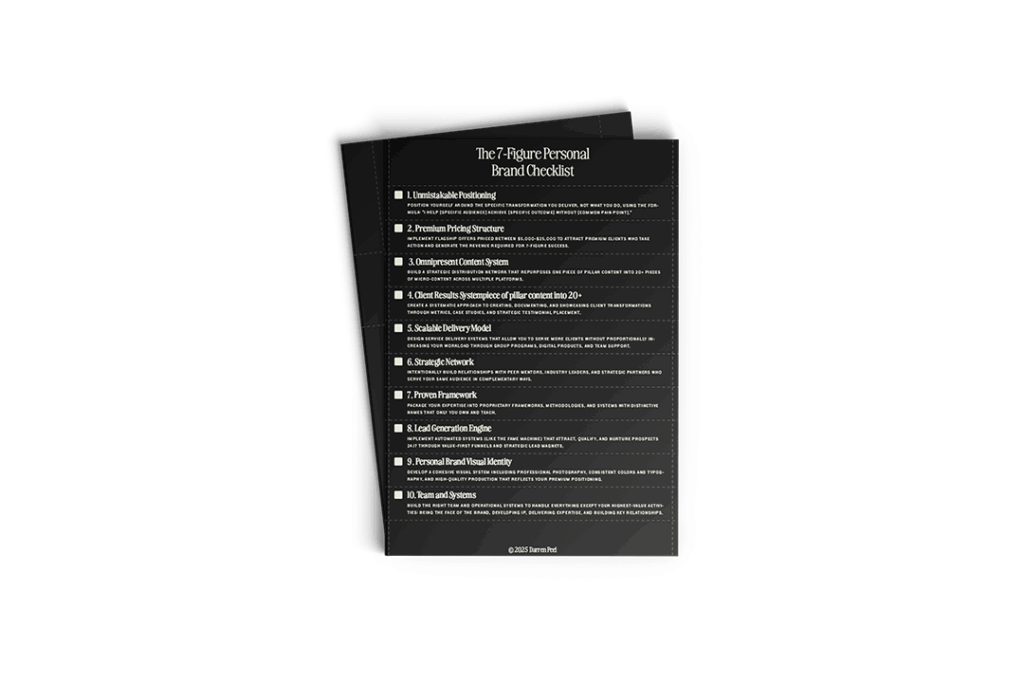
In this guide, I’m breaking down the exact trends that are separating million-dollar personal brands from everyone else. These aren’t theories or predictions—these are strategies I’ve extracted from working with 183+ affluent personal brands over the last 12 months.
You’ll discover why micro-offers are replacing traditional funnels, why educational content is becoming a commodity, and why the most successful brands are actively shrinking their addressable market. Plus, I’ll show you exactly how to implement each trend with specific frameworks and examples.
Let’s dive in.
What Is Personal Branding in 2026?
Personal branding in 2026 is fundamentally different from what it was even two years ago. It’s no longer about being “known”—it’s about being known for the right things by the right people.
Here’s the shift: Old personal branding was about reach, followers, and visibility. New personal branding is about authority, positioning, and premium pricing. It’s not about how many people know you—it’s about whether the people who matter see you as the only logical choice.
The brands crushing it right now aren’t the ones with the biggest audiences. They’re the ones with the most trust, the clearest positioning, and the strongest proof. They’ve stopped trying to appeal to everyone and started dominating hyper-specific niches with premium offers.
If you’re still focused on growing your follower count as a primary metric, you’re already behind.
Why Personal Branding Matters More Than Ever in 2026
The trust recession is real, and it’s getting worse. With AI making it trivially easy to fake expertise, create polished content, and look like you know what you’re doing, people have become incredibly skeptical.
They can’t tell who’s actually built something versus who’s just good at talking about building things. They can’t distinguish between real experts and people regurgitating AI-generated advice. And they’re exhausted by perfectly curated “expert” content that all looks and sounds the same.
This creates a massive opportunity for people willing to build authentic personal brands the right way. Because when you can demonstrate real expertise, show actual proof, and build genuine trust, you become extraordinarily valuable in a market flooded with fakes.
The personal brands winning in 2026 are the ones that understand this shift and are positioning themselves accordingly. They’re not trying to be the loudest voice in the room—they’re becoming the most trusted voice in their specific niche.
Trend #1: Micro-Offers as Brand Builders
This might be the most counterintuitive trend on this list, but it’s also one of the most powerful.
The Old Model Is Dead
For years, the conventional wisdom was: build a massive free audience, nurture them with content, then pitch them on high-ticket coaching or consulting. Maybe you’d convert 1-2% if you were lucky.
The problem? This model treats your audience like they’re idiots who need months of “warming up” before they’re ready to buy. It’s inefficient, slow, and frankly, kind of disrespectful.
The New Model: Micro-Offers
Here’s what’s working: Create a low-ticket product ($27-97) that teaches your core framework or methodology. Not to make profit. To manufacture trust and authority at scale.
When someone pays you—even just $27—something magical happens psychologically. They shift from “content consumer” to “paying customer.” They start seeing you differently. You’re no longer just another person giving away tips on Instagram. You’re someone who creates transformational products they’re willing to pay for.
Why This Works
Let’s say you create a $67 mini-course teaching your signature framework. You run targeted ads to it. Over three months, 500 people buy it.
Now you have 500 warm leads who have:
- Paid to learn from you (demonstrating buying behavior)
- Consumed your framework (understanding your methodology)
- Self-identified as people with this problem (qualifying themselves)
- Started seeing you as an authority (positioning effect)
When you pitch your $5K-$15K high-ticket program to these people, they convert at 10-15% instead of the 0.8-2% you’d get from a cold free audience.
Real Example
One of my clients, a business coach, created a $37 mini-course called “The Profitable Positioning System.” In three months, 847 people bought it. Her $10K coaching program now sells to 12% of mini-course buyers versus 0.8% of her free audience.
The math is simple: Would you rather have 50,000 free followers converting at 0.8% (400 buyers) or 1,000 micro-offer buyers converting at 12% (120 buyers who already paid you and understand your methodology)?
The micro-offer isn’t the product. It’s the most powerful lead generation and authority-building mechanism available in 2026.
Trend #2: Belief-Shifting Content Over Education
This trend is going to mess with a lot of people because we’ve been conditioned to think that “adding value” means teaching people how to do things.
But here’s the uncomfortable truth: in 2026, nobody needs more how-to content.
Information Is Infinite, Perspective Is Scarce
ChatGPT can teach anyone how to do anything in 30 seconds. YouTube has 10,000 videos on every possible topic. If someone wants to learn “how to write better headlines” or “how to structure a sales call,” the information is everywhere and it’s free.
What AI can’t do—what most content creators can’t do—is challenge the fundamental beliefs and assumptions people hold that are keeping them stuck.
The Shift
Educational content: “5 Steps to Better Email Marketing” Belief-shifting content: “Why Your Email Marketing Is Failing: You’re Solving the Wrong Problem”
See the difference? The first teaches tactics. The second reframes the entire conversation. It says, “Everything you think you know about this is wrong, and here’s a completely different way to think about it.”
Why This Builds Authority
People don’t change because they learn new information. They change because their worldview gets disrupted. When you challenge someone’s deeply held belief and give them a new lens to see their problem through, you’re not just educating them—you’re transforming how they think.
That positions you as a thought leader, not just another educator.
Real Examples
Alex Hormozi doesn’t teach “how to run Facebook ads” (that’s commodity information). He says things like “Most business problems aren’t marketing problems—they’re offer problems.” He’s reframing how people think about their entire business.
Naval Ravikant doesn’t teach “how to get rich.” He says “You will not get rich renting out your time.” He’s challenging the fundamental belief that trading time for money is the path to wealth.
These aren’t tips. These are perspective shifts. And perspective is infinitely more valuable than information in an AI-saturated world.
How to Create Belief-Shifting Content
- Identify what your audience believes that’s keeping them stuck
- Challenge that belief with evidence or logic
- Provide the alternative belief
- Prove it with case studies or data
- Show what becomes possible when they adopt the new belief
If you want to be seen as a thought leader instead of just another educator, you have to be willing to challenge beliefs, not just share information.
Trend #3: Micro-Documentary Content
People are getting exhausted by perfectly curated “expert” content. They’re craving something real.
The Trust Recession
We’re in what I call the trust recession. With AI making it easy to fake expertise, people can’t tell what’s real anymore. They can’t tell who’s actually built something versus who’s just good at talking about building things.
Micro-documentary content solves this problem.
What Is Micro-Documentary Content?
Instead of creating perfectly scripted content explaining concepts, you create short-form documentary-style content showing the behind-the-scenes of your business and life.
Instead of talking about how to do something, you show yourself actually doing it.
Real Examples That Work
Codie Sanchez: Instead of posting “How to buy a business” tutorials, she posts raw footage of her touring a laundromat she’s buying, showing the numbers, asking the owner questions, making the offer—all in 60-second clips. You feel like you’re there with her.
Leila Hormozi: Instead of creating “How to scale a company” carousel posts, she posts clips from actual executive meetings, showing her coaching her team through problems, making real decisions, dealing with real challenges. You trust her because you’ve seen her do the work.
Dan Martell: Instead of posting “Time management tips” reels, he films his actual morning routine at 5:30am—raw, unpolished, showing his workout, his planning process, his family time. You connect with him as a human, not just a “productivity expert.”
Why This Is Powerful
First, it’s nearly impossible to fake. AI can generate tips and tactics all day long, but it can’t generate authentic footage of you building your actual business.
Second, it creates emotional connection at a depth that educational content never will. When people see you struggle, make decisions, and deal with real challenges, they start to know you. Not just know of you—actually know you.
And people don’t trust faceless brands anymore. They want to know who’s behind the business. What do you stand for? What do you believe? What’s your actual story?
If you’re not showing the behind-the-scenes of your business, your thought process, your real day-to-day, you’re leaving massive amounts of trust—and therefore revenue—on the table.
Trend #4: Hyper-Niche Ownership
This might be the most counterintuitive trend on this list. Most people are terrified of niching down because they think it limits their market.
The opposite is true.
The Specificity Paradox
Here’s the shift: Instead of “fitness coach,” it’s “strength training for female entrepreneurs over 40 who travel frequently.”
Instead of “marketing consultant,” it’s “email marketing for B2B SaaS companies selling to CFOs in the manufacturing space.”
Your first instinct is probably: “Won’t I limit my market? Won’t I make less money?”
The answer is the exact opposite. The more specific your niche, the higher your prices and the stronger your brand loyalty.
Why This Works
Let’s say you’re a female entrepreneur over 40 who travels constantly and struggles with fitness. Who are you going to hire?
The generic “fitness coach for busy professionals” who charges $197/month? Or the person who exclusively works with women exactly like you, has a program specifically designed for your exact situation, and charges $997/month?
The generic coach has to compete on price because they’re interchangeable. The hyper-niche specialist can charge 3-5x more because they’re seen as the only logical choice.
Mass Appeal Is Out
Here’s what I’m seeing right now: Mass appeal is out. Clear positioning. Clear taste. Clear values. That’s in.
The brands winning aren’t trying to be for everyone. They’re saying, “This is exactly who I’m for. If that’s you, you’ll love working with me. If it’s not, that’s okay—I’m not for you.”
This creates magnetic attraction from your ideal clients and complete indifference from everyone else. And that’s exactly what you want.
How Specific Should You Get?
Your positioning should make you slightly nervous. If it doesn’t, it’s not specific enough.
Include at least three of these elements:
- WHO: Demographic specificity (gender, age, profession, industry)
- WHAT: Problem specificity (exact challenge, exact outcome)
- WHERE: Situational specificity (revenue level, life stage, location)
- WHY: Psychographic specificity (values, beliefs, identity)
- HOW: Methodology specificity (your unique approach/framework)
If your positioning statement is vague enough that 10,000 other people could say the exact same thing, you need to get more specific. Way more specific. Uncomfortably specific.
Trend #5: The Prove-It Culture
We’re deep in a trust recession. Anyone can call themselves an expert. Anyone can regurgitate whatever their latest ChatGPT prompt spewed out. Anyone can create a polished website and slick Instagram feed.
So people have gotten smart. They’ve gotten skeptical. And they’re demanding one thing: proof.
What Proof Looks Like
Not vague testimonials like “Working with Sarah changed my business!”
Real proof:
- Specific case studies with names, numbers, screenshots
- Video testimonials from real clients
- Live demonstrations of your work
- Transparent metrics from your own business
- Before/after comparisons with detailed breakdowns
The Brands Winning
Alex Hormozi: Posts screenshots of Acquisition.com’s revenue. Shares detailed case studies of portfolio companies. Shows before/after financials. Films real portfolio company meetings. When he says something works, people believe him because they’ve seen the receipts.
Codie Sanchez: Shows bank statements from businesses she’s bought. Posts P&L statements. Shares deal flow and due diligence. Films actual negotiations. You trust her because you’ve seen the actual numbers.
Justin Welsh: Posts monthly revenue reports. Shares email subscriber growth graphs. Shows analytics dashboards. Breaks down exactly how much each product makes. His transparency builds massive trust.
Why This Trend Is Accelerating
As AI makes it easier to fake expertise, the premium will be on people who can prove they have real expertise. The people who can say “Don’t just take my word for it. Here are 50 people whose businesses I’ve transformed. Here are the specific results. Here are their video testimonials.”
If you’re building a personal brand in 2026 and you’re not obsessively focused on generating and sharing proof, you’re going to get left behind.
Trust is the scarcest resource in the attention economy. And proof is the only currency that buys it.
Best Practices for Building a Personal Brand in 2026
Now that you understand the trends, here’s how to actually implement them:
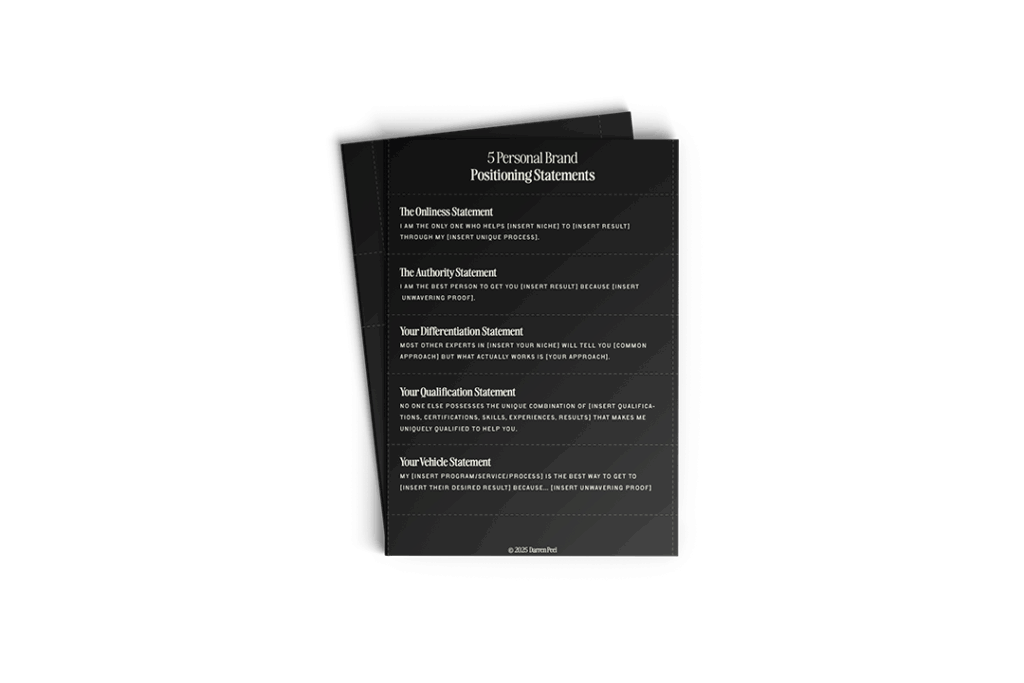
Start with positioning. Get uncomfortably specific about who you serve. If your positioning doesn’t make you nervous, you haven’t niched down enough.
Create your micro-offer immediately. Don’t overthink it. Take your core framework, package it as a mini-course or template library, price it at $27-97, and launch it. Version 1 doesn’t need to be perfect.
Shift your content strategy. For every piece of educational content you create, create two pieces of belief-shifting content. Challenge assumptions. Take contrarian positions. Reframe problems.
Start filming everything. Pull out your phone and start recording 30-second clips of you actually doing your work. Client calls. Strategy sessions. Decision-making. The messy reality. Post 3 pieces per week.
Build your proof library. Create detailed case studies of your best client wins. Collect video testimonials. Share transparent metrics. Make proof a core part of your content strategy.
Consistency over perfection. None of these trends require you to be perfect. They require you to be consistent, authentic, and strategic.
Common Challenges (And How to Solve Them)
Challenge 1: “I’m afraid of niching down too much”
Solution: Test it. Pick a hyper-specific niche, update your positioning, and run 10 sales conversations. Track whether price resistance goes up or down. I guarantee it goes down. The specificity gives you permission to charge more, not less.
Challenge 2: “I don’t know what micro-offer to create”
Solution: Look at what you charge clients $5K-15K for. What’s the core framework or methodology? Package that as a standalone mini-course. It doesn’t need to be comprehensive—it needs to deliver one clear outcome.
Challenge 3: “I don’t have enough proof yet”
Solution: Start generating it intentionally. Work with 3-5 clients at a discount in exchange for detailed case studies and video testimonials. Document everything. Share the journey, not just the destination.
Challenge 4: “Documentary content feels too vulnerable”
Solution: Start small. You don’t need to share your deepest struggles on day one. Begin with behind-the-scenes of your work process. Show how you think through problems. Build comfort over time.
Challenge 5: “Creating belief-shifting content is harder than educational content”
Solution: It is harder. That’s why most people don’t do it. And that’s exactly why it’s valuable. Start by listing 10 things your audience believes that are wrong. Pick one per week and challenge it.
Tools and Resources for Modern Personal Branding
For Creating Micro-Offers:
- Kajabi or Teachable: Course hosting platforms ($149-199/month)
- Gumroad: Simple digital product sales (Free + 10% transaction fee)
- Stan Store: All-in-one creator commerce platform ($29/month)
For Belief-Shifting Content:
- Claude or ChatGPT: Brainstorm contrarian angles and research supporting evidence
- Notion: Organize your false belief inventory and content ideas
- Hemingway Editor: Keep your writing clear and punchy
For Documentary Content:
- Your smartphone: Seriously, that’s all you need
- CapCut: Free video editing app
- Descript: AI-powered video editing ($12/month)
For Proof Building:
- Loom: Record video testimonials and case study walkthroughs (Free)
- Testimonial.to: Collect and manage video testimonials ($20/month)
- Notion or Airtable: Build your case study library
For Hyper-Niche Research:
- SparkToro: Audience research tool to understand your niche ($50/month)
- Facebook Groups & Reddit: Where your hyper-specific audience congregates (Free)
- 1-on-1 Interviews: Talk to 10 ideal clients to understand their exact language
Frequently Asked Questions
Q: Is it too late to start building a personal brand in 2026?
A: Not at all—but you need to use the strategies that actually work now, not the ones that worked in 2023. The barrier to entry is higher (more competition, AI saturation), but the opportunity for those who do it right is bigger than ever. Focus on proof, positioning, and trust.
Q: How long does it take to build a million-dollar personal brand?
A: With the right positioning and strategy, 18-36 months is realistic for most coaches and consultants. But this assumes you’re implementing all 5 trends consistently, not just posting content and hoping for the best.
Q: Do I need a big following to make good money?
A: Absolutely not. I have clients with 3,000 followers making $500K+ per year because they have the right positioning, premium pricing, and strong proof. A small audience of the right people is infinitely more valuable than a huge audience of the wrong people.
Q: Should I be on every social platform?
A: No. Pick 1-2 platforms where your ideal clients actually are and dominate those. Being mediocre on five platforms is worse than being excellent on one.
Q: How much should I charge for my services?
A: Price based on the transformation you create, not the time you spend. If you help clients generate $500K in additional revenue, charging $30K is a no-brainer. The more specific your niche and stronger your proof, the higher you can price.
Q: What if my niche is too small?
A: If you can find 100-200 people in your hyper-specific niche who would pay premium prices, that’s more than enough to build a 7-figure business. You don’t need millions of people—you need the right people.
Q: How do I know which trend to start with?
A: Start with positioning (Trend #4). Get crystal clear on your hyper-niche. Then create a micro-offer (Trend #1). Everything else flows from those two foundations.
Q: Can I use AI to create my content?
A: Use AI for research, ideation, and drafting—but your final content needs your unique perspective, voice, and experiences. AI can’t challenge beliefs or shift perspectives like you can. Use it as a tool, not a replacement.
Key Takeaways: What You Need to Remember
Personal branding has fundamentally changed. The strategies from 2023—educational content, follower growth, being helpful—are now building audiences full of people who won’t buy. Adapt or become irrelevant.
Micro-offers are trust accelerators. Stop building massive free audiences. Create $27-97 products that manufacture trust and convert buyers at 10-15% instead of 0.8-2% from cold traffic.
Perspective beats information. Educational content is commodity. Belief-shifting content that challenges assumptions positions you as a thought leader. Focus on changing worldviews, not just teaching tactics.
Documentary content builds trust AI can’t fake. Show your real work, real struggles, real decision-making. People don’t trust faceless brands—they want to see who you actually are.
Hyper-specificity commands premium prices. Mass appeal is death. Get uncomfortably specific with your positioning. The more specific your niche, the higher your prices and stronger your brand loyalty.
Proof is the only currency that matters. We’re in a trust recession. Share case studies, transparent metrics, video testimonials, and live demonstrations constantly. Your proof library is your most valuable asset.
Next Steps: How to Implement This Starting Today
Ready to actually do this? Here’s your action plan:
Immediate Actions (This Week):
Define your hyper-niche. Use the specificity formula: Who (demographics) + What (problem) + Where (situation) + Why (psychographics) + How (your methodology). Make it uncomfortable.
Audit your content. Review your last 20 posts. How many are educational vs belief-shifting? How many show documentary-style behind-the-scenes? Adjust your ratio.
Start your proof library. Reach out to 3 past clients. Ask for video testimonials. Create one detailed case study with specific numbers and screenshots.
Short-Term Strategy (Next 30 Days):
Create your first micro-offer. Package your core framework as a mini-course, template library, or workshop recording. Price it $27-97. Launch to your existing audience. Goal: 20-50 buyers in month one.
Shift your content. Post 3 belief-shifting pieces and 3 documentary pieces per week. Track engagement compared to your old educational content. Double down on what works.
Film everything. Start recording 30-second clips of your actual work. Client calls (with permission), strategy sessions, decision-making, behind-the-scenes. Build your content library.
Long-Term Strategy (Next 90 Days):
Build your authority ecosystem. Micro-offer generating qualified leads → Email sequence sharing proof and belief shifts → Case studies demonstrating results → High-ticket program closing at 10-15%.
Become a proof machine. Share weekly client wins. Post monthly transparent metrics. Create quarterly detailed case studies. Make proof a core part of your brand.
Refine and optimize. Track what’s working. Which positioning gets the best response? Which content drives the most trust? Which proof converts best? Double down on winners.
The personal brands that implement these 5 trends will build 7-figure businesses with premium pricing and ideal clients. The ones that don’t will keep grinding on outdated strategies wondering why it’s getting harder.
The choice is yours.
Ready to build a million-dollar personal brand? Download the free 2026 Personal Branding Roadmap with complete frameworks, templates, and implementation exercises for all 5 trends.
Want help implementing this? If you’re a coach or consultant doing $100K+ and ready to scale to 7-figures with premium positioning, apply to work with me and let’s build your brand the right way.
Keywords: personal branding 2026, how to build a personal brand, personal brand strategy, thought leadership, content strategy 2026, premium personal brand, personal branding for coaches, personal branding for consultants, hyper niche marketing, micro offers, belief shifting content, million dollar personal brand, personal brand positioning, how to charge premium prices, authority building